

Joe Schulte shared the following clippings from his research of The Ellinwood Leader.
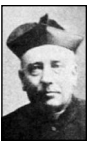 Death of Father Emmerich
Ellinwood Leader, September 8th, 1932
PIONEER PRIEST BURIED AT ODIN
Father Emmerich, who had spent the nine years since his retirement at the Pflugi home in Ellinwood, died quietly Wednesday evening at 7: 20.
He held services in the early settlers’ huts and sod houses or in the open. He slept under the stars, and frequently lived on the game which abounded about him as he travelled from one isolated settlement to another. He was known on the border of Colorado, near the Nebraska line, and in the Wilderness, which then was Indian Territory.
Just how long this period of his life lasted is uncertain, but it is known definitely that he was assigned his first definite station 52 years ago when he became the parish priest at Odin. Claflin was virgin prairie then, and Ellinwood and Wilson were his supply points.
His assignment to Odin did not end his nomad life, however, for he was the only station priest in many miles, and he rode a circuit which took to Cane City, Raymond, McPherson, and many other cities in this territory.
He was a familiar sight over a wide area, and his term of roan ponies, which he used for transportation, most of the time, was known for many miles. During the winter, he suffered hardships frequently as he made the trip to Ellinwood or Wilson for supplies while wintery blizzards howled above his head.
Father Emmerich was a shrewd man, as well as a benevolent and kindly one. He always paid what he owed, but he was a good trader, and on his trips he often bought or sold horses, pigs, oxen, and other commodities which were values in the pioneer days. Hence, in spite of his scanty salary, he always had funds with which to fight poverty among his parishioners, and the early settlers in his territory.
Father Emmerich labored for 16 years at Odin, and then took charge of the Ellinwood church. Even then he was a circuit rider, as he also conducted services at Sts. Peter and Paul, and frequently was called to other communities.
He not only was responsible for building the Ellinwood church, but he financed a great deal of it single handed. Of course many of his parishioners donated labor and material, but the foundation was his own gift. Not until the church had been built up to the windows did Father Emmerich seek donations for its construction. Then with a foundation, and a good start of the walls he did not have much difficulty obtaining funds to complete the work.
When a new $2500 copper roof was needed Father Emmerich found the funds, and he paid for the paving around the church out of his own pocket.
Nine years ago, he retired to the Pflugi home, across the street from the church, but he did not retire from his philanthropic work. He has helped many a family since that time. His ability to do this was due as much to his own frugality, as to his ability to accumulate money. All of his life he lived frugally and simply, that he might have the more with which to help others.
September 29th, 1932
Father Werner Emmerich, generous to his parish in life, was as generous in death, his will reveals. The largest gift made under the will was a bequest of $6,000 given outright to St. Joseph’s Parish. In addition to this $1,000, which Father Emmerich loaned to the parish, during his life, was canceled at his death. The loan was made with the understanding that Father Emmerich was to receive interest during his life, but that the principal was to become the property of the parish at his death.
These gifts bring the total of Father Emmerich’s gifts to St. Joseph Parish in the neighborhood of $12,000, as he always was the first to subscribe to any project which the church financed through subscriptions. At the time the paving was laid by the church he headed the list of donors with a gift of $500, and he contributed to the fund to reroof the church and to many other parish projects, in addition to his own private charities.
Sisters’ House
Ellinwood Leader, August 30th, 1934
Despite the fire which destroyed the sisters’ home recently, St. Joseph School will open as schedule on Labor Day, September 3rd.
The Sisters of the Precious Blood from St. John’s Academy arrived Wednesday to administer the school. Temporary quarters for them are being arranged in the school building. Other arrangements will be made later.
Sisters’ House
Ellinwood Leader October 18, 1934
Hoping to complete their job by Christmas, laborers are pushing construction of the new home for the sisters of St. Joseph’s Parochial School. The basement has been completed and work on the substructure started this week.
The building, of brick veneer construction, is to be 29 feet ten inches by 36 feet ten inches, two story with a full basement. It will be large enough to meet the present demand for teachers and the needs of the parish for many years to come. An asbestos roof will make it thoroughly fire proof.
The architecture is in the conventional convent style and the interior is to be modern in every respect. The approximate cost of the building has been set at $10,000. Joe Dressen is supervising the work.
New Rectory
Ellinwood Leader December 12, 1940
A new priests’ home to replace the antiquated frame structure now in use by St. Joseph’s Parish has been planned, but building will not start until ample funds are obtained for the project. Some materials, however, have been obtained for the new building and now are stored in the yard of the priests’ house.
.jpg) Sts. Peter and Paul
Sts. Peter and Paul
Ellinwood Leader, September 28, 1944
Lack of space last week made it impossible to include all of the interesting material that might have been written about P.B. Kimpler and the interesting stories about his family here in the early days.
Mr. Kimpler often told of the exciting scenes of his earliest days in Kansas. He remembers seeing a great migration of Indians, probably from one reservation to another, which took several days to pass Ellinwood. The Indians straggled along, a family group as a time, and the line of them stretch across the prairies as far as the eye could see. Buffalo still were plentiful when Mr. Kimpler came to Kansas, and he engaged in many an interesting hunt.
Another interesting story concerns the old church bell which Mr. Kimpler’s father purchased in the East with proceeds of his first wheat crop, which was used for church when the early missionary arrived for services.
Once, Mr. Kimpler recalled, a terrible tornado was visible coming across the prairie. A group of people gathered at what is now Sts. Peter and Paul corner to watch the storm, and it seemed to be heading directly for them. Mr. Kimpler’s father and others ran to the barn and rang the old bell, and it seemed as if a miracle happened before their eyes. The tornado came to earth where Sts. Peter and Paul School now stands, made a considerable hole in the ground, and then bounced over the assemblage, just across the road and went on to do extensive damage at the edge of the bottoms. No one in the group was hurt.
After Sts. Peter and Paul Church was built, the old bell no longer was used until a call came from a poor parish in Oklahoma that needed a bell. The bell was sent to that church and was used for a number of years. Later the church purchased a bell and returned the Kimpler bell. For a time, it sat in George Kimper’s yard. Father Steines was the priest at Belpre at the time, and the Belpre church needed a bell, so the old bell was loaned to the Belpre church and still is in service there. The later Bishop Schwertner gave the Kimpler family a document attesting their ownership of the bell and providing that it should be returned to the family when the church at Belpre no longer needs it.